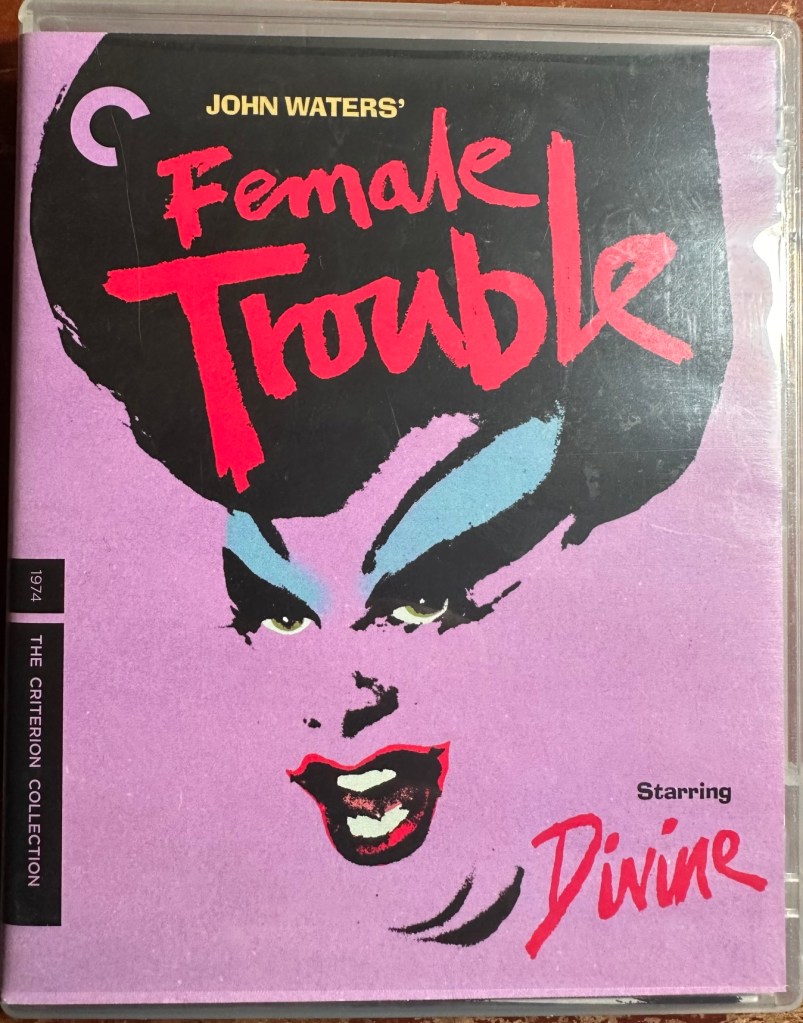
Directed by John Waters
Written by John Waters
1974 | 97 minutes | English
Criterion Blu-Ray
Divine, David Lochary, Mary Vivian Pearce, Mink Stole, Edith Massey, Cookie Mueller, Susan Walsh, Michael Potter, Ed Peranio, Paul Swift, George Figgs, Susan Lowe, Channing Wilroy, Elizabeth Coffey
What it’s about: The story of Dawn Davenport (Divine), who begins as a wayward teen in the 1960s. In a fit of rebellion, she has sex with the sleazy Earl Preston (also Divine) and gets pregnant, but Earl leaves her in the lurch. By the 1970s, Dawn has turned to a life of thievery and crime and clashes frequently with her now teen daughter Taffy (Stole) and also with Aunt Ida (Massey), the relative of her no-good husband Gater (Potter) who lives next door. But the Dashers (Lochary and Pearce), the aesthete owners of the beauty salon where she hangs out, have big plans for Dawn, and once she gets a taste of fame, absolutely nothing is going to stand in her way.
Reflections: Coming off the unexpected success of Pink Flamingos, Waters and his merry band made the wise choice not to try and top the shock-value of that film, instead refining their micro-budget craft into something more like a bonkers melodrama. It’s still early John Waters, though–a celebration of irreverent trash, thick with a confrontationally gross sexuality, a glee in cartoonish violence, and a sympathetic lust for the weird, offputting, and disgusting things shunned by normie society. But “celebration” is a key word there–it works because as nasty and freakish and mocking as it can be, it’s done without punching down and with the deepest of camp sensibilities. Dawn is, objectively, a monster, but the film begs the question: “Yeah, but haven’t you ever wanted to just go apeshit?” And then has a hoot imagining what that could look like.
And by god, Divine sells it. He channels a star power in all his work–an Old Hollywood glamour filtered through whacked-out 1970s post-modernity–but was maybe never more into it than here. Dawn is tragic and vulnerable one moment, brutish and feral the next, and it all works. The rest of the Dreamlanders aren’t quite on the same level, but are clearly having a great time with it, delivering Waters’s unhinged dialogue with relish (highlights include Ida trying to convince Gater he’s too smart to be straight, or Taffy bellowing “I wouldn’t suck your lousy dick if I were suffocating and there was oxygen in your balls!”). And you can see the director’s craft evolving–while still far outside mainstream studio filmmaking, the whole thing is tighter and more composed than his previous three, full of wacky colors and elaborate and busy sets, a looming, jumpy camera, and even a goofy theme song co-written by Waters and sung by Divine.
There’s something weirdly comforting about a John Waters movie–a sense of freedom that few filmmakers are able to convey so intelligently and effectively, even fewer while being so unpretentious about it. A lot of people (including film scholar Ed Halter, in the Criterion booklet) consider this to be maybe the clearest distillation of his early, more independent work and, watching it for the second time and first time in years, it’s not hard to see why. Weird, subversive, and a great time.
 Yeah Dude, Okay