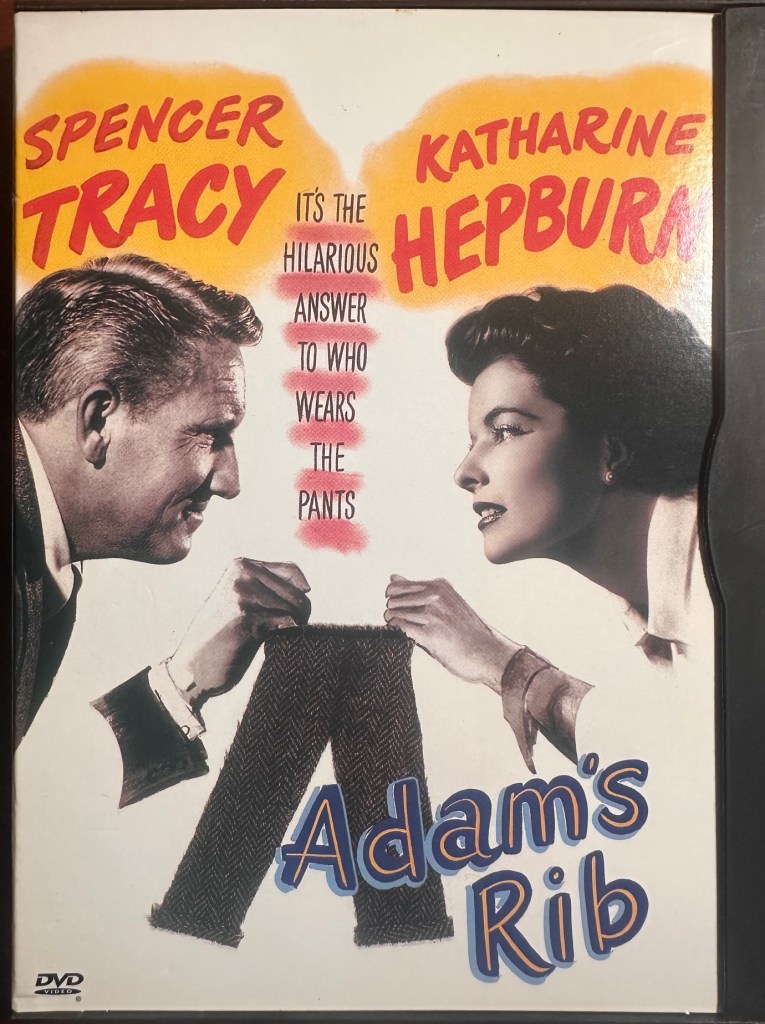
Directed by George Cukor
Written by Ruth Gordon & Garson Kanin
1949 | 100 minutes | English
DVD
Spencer Tracy, Katharine Hepburn, Judy Holliday, Tom Ewell, David Wayne, Jean Hagen, Hope Emerson, Clarence Kolb, Emerson Treacy, Polly Moran, Will Wright
What it’s about: Adam “Pinky” Bonner (Tracy) and Amanda “Pinkie” Bonner (Hepburn) are a married pair of high-powered New York attorneys, him working with the D.A.’s office and her in private practice. When a young wife and mother, Doris Attinger (Holliday) nonfatally shoots her philandering husband Warren (Ewell), it puts the two of them into a spirited debate about the rule of law versus the pressures and prejudices faced by put-upon women. But when Adam’s office assigns him to prosecute the case, and Amanda, incensed at the injustice, reaches out to take up the defense, the couple is put into direct conflict in the courtroom. And the resulting strain on their relationship is exacerbated by Kip Lurie (Wayne), a playboy neighbor and songwriter who barely disguises his contempt for Adam and writes a hit song lusting after Amanda.
Reflections: The all-time classic “battle of the sexes” film, it has the setup of a zany screwball comedy. And it is ultimately a comedy, not shy about dipping into wackiness and wittiness when it wants to: the scene where Amanda has a female weight-lifter (Emerson) hoist up Adam in the middle of court, or Kip’s dryly-bladed running commentary on the Bonners’ home movies during a party scene. But Gordon and Kanin’s Oscar-nominated script (it lost to Sunset Boulevard, which I suppose is fair) is interested in more serious drama also. This is a film written by a married couple, starring a couple–not married, but engaged in a long affair–and it takes the personal complexities of maintaining an intimate heterosexual relationship seriously. And, honestly, that so many echoes of a rapidly-shifting postwar society still feel relevant seventy-odd years later is both comforting and a little depressing, but the charm and sophistication with which the story is told helps it all go down easy.
Tracy and Hepburn, in the sixth of their nine films together, have their dynamic perfected at this point–she has this fiery fearlessness that covers up a soft underbelly and his folksy, easygoing exterior is wrapped around an iron-clad conviction and stubbornness. The characters around them are all a little more cartoonish–Kip’s Pepe le Pew-esque attitude toward Amanda, Jean Hagen as Warren’s sleazy bimbo mistress, etc.–but the focus never strays far from the leads and they way they handle the chaos. There is a scene where Amanda, running at full intensity, is straining to keep her patience interviewing the wounded, airheaded Doris that’s a perfect microcosm of what’s going on here: Cukor’s notably queer sensibility as a director wrings both humor and sympathy out of all of it, without ever going too far or passing judgment.
And, of course, it all ends up alright. I’ve seen this one a few times now and it’s easy to go back to–serious but not bleak, sentimental but not pejoratively, smartly observed on all levels and, for better or for worse, timeless. An essential part of the canon. And “Farewell Amanda” has been stuck in my head since I watched it.
 Yeah Dude, Okay