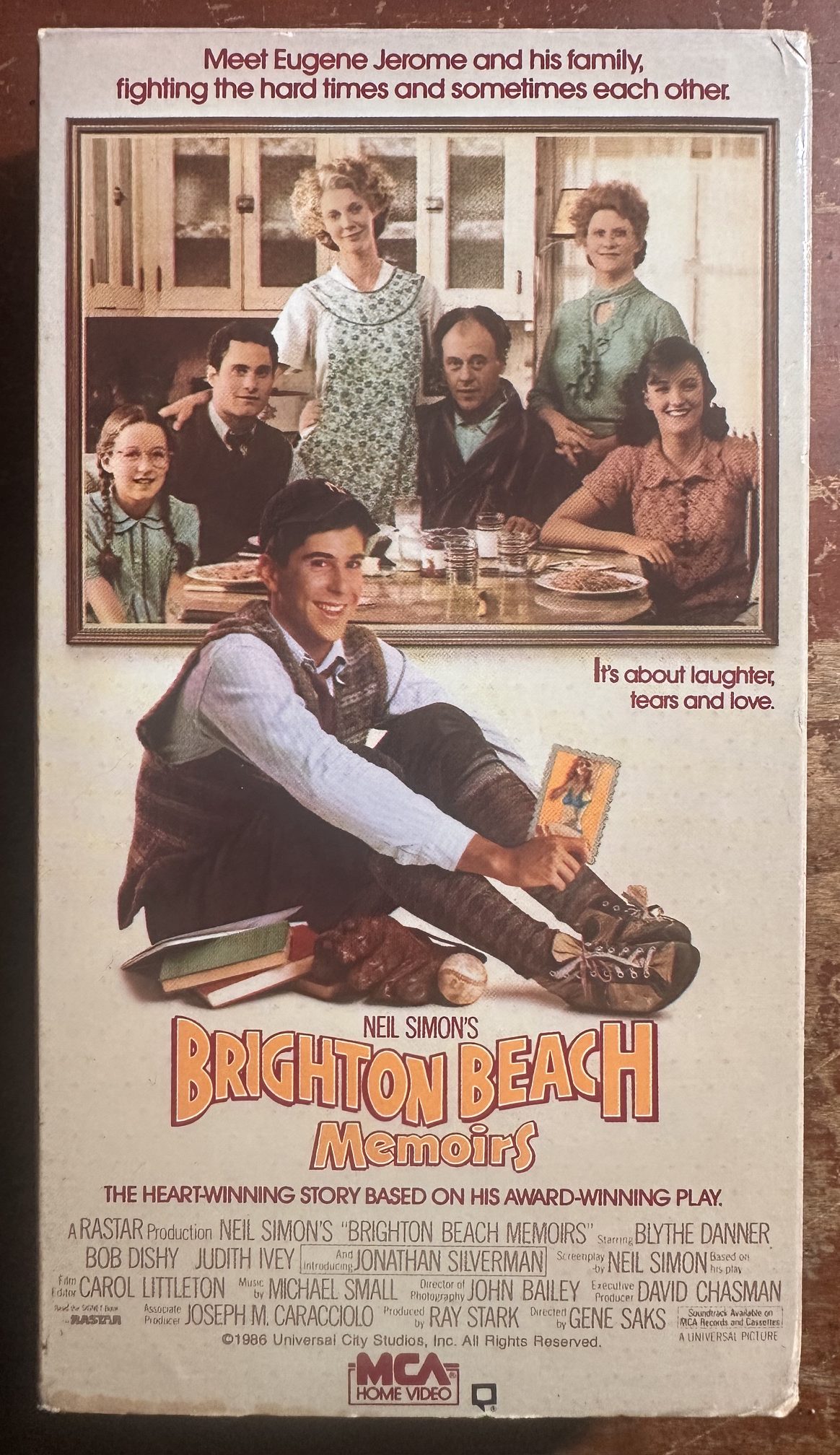
Directed by Gene Saks
Written by Neil Simon
1986 | 110 minutes | English
VHS
Jonathan Silverman, Blythe Danner, Bob Dishey, Judith Ivey, Brian Drillinger, Stacey Glick, Lisa Waltz, Alan Weeks, Jason Alexander, James Handy
What it’s about: It’s 1937, Brooklyn, and the memoirs are those of Eugene (Silverman), a basically good kid of nearly 15 who is wrestling a wise-ass streak and some raging hormones amidst the chaos of the rest of his family. His mother Kate (Danner) is wound tight, trying to keep everything together: her widowed sister, Blanche (Ivey) is a shy, withering woman who might have a chance with the Irish man across the street (Handy) of whom Kate doesn’t approve. Blanche’s elder daughter Nora (Waltz) is pushing for an opportunity to audition for a Broadway show, even though it would mean missing school. Eugene’s older brother, Stanley (Drillinger) is struggling to find his way and contribute to the family, as their father Jack (Dishy) is overworking himself at two jobs to keep everyone afloat. And Eugene’s younger cousin, Laurie (Glick), who’s heart has a palpitation, is wryly observing it all.
Reflections: Contemporary reviews suggest that this film adaptations blunts some of the edge of Simon’s original play, but in my experience with it now, that’s its primary charm. There is a coziness to it, a nostalgic innocence, decades removed from my own childhood, but which fed into it from older generations. Eugene, as a narrator, is sweet but not saccharine–equally fascinated to learn about masturbation as he is concerned about the larger things of life. The stakes are serious–concern for family in an increasingly tense Europe, the economic anxiety of carrying the family through the Depression era, familial roles that unfairly shape responsibilities and regrets–but nothing is ever completely dire. There is a slightly artificial sheen, a neatness to everything, that ends up feeling a little bland, but also weirdly comforting.
As a film, the theatrical origins bleed through a bit–characters talk in long, often emotional exchanges, peppered with callbacks, witticisms, and colorful phrases. Danner and Ivey are the standout performances, grounding their characters and falling into the “golly-gee” tone of the script the least. The design and look of the film are soft and warm, which fit neatly into the overall wistful feeling, and when the action does open up slightly–Eugene charging down the street, running a milk-bottle like a football, for example–there is some fun to be had in the movement.
As I was watching it, I couldn’t help but think that it came out the same year as Ferris Bueller’s Day Off, another film with a teenage boy breaking the fourth wall to explain his life. But where John Hughes’s film is grounded in its (then) modernity, a young voice speaking forward, this one is the voice of someone older looking back. It’s not really that things were simpler, then–as Eugene observes, there always comes a moment where childhood ends. But there is a sense of reassurance in looking back, having grown up, and that’s the exercise of this. It’s a mild, old-fashioned mac-and-cheese kind of movie, but that’s not a criticism–those have their place, and I had fun with it.
 Yeah Dude, Okay