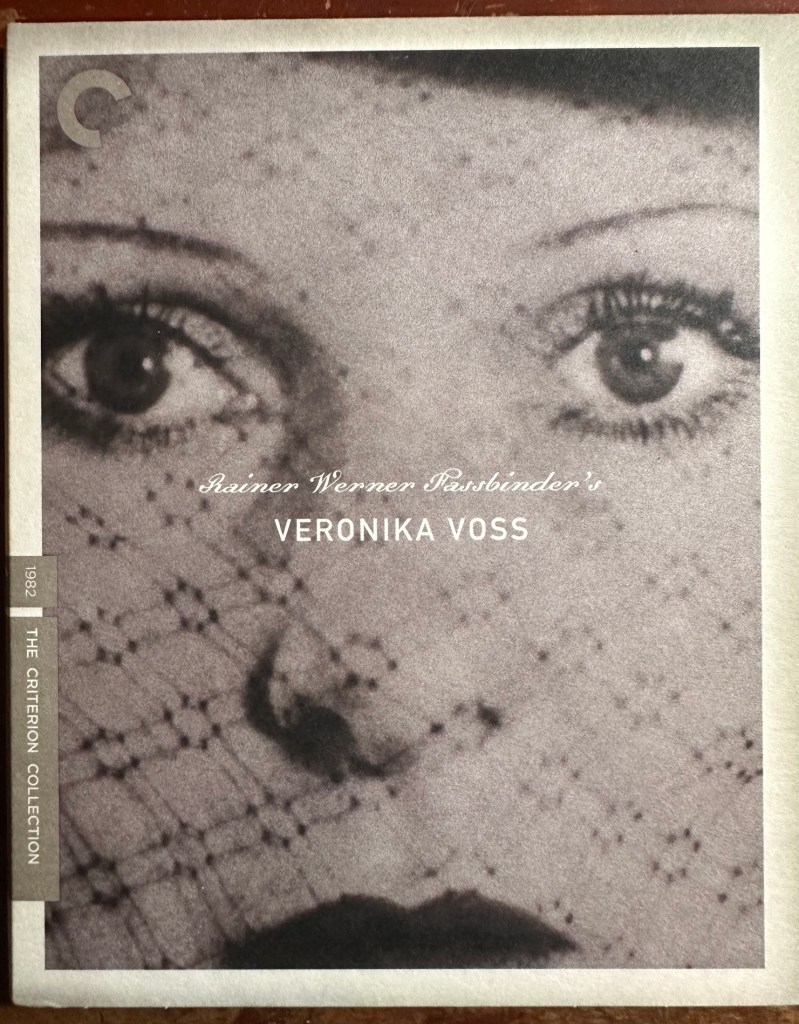
Directed by Rainer Werner Fassbinder
Written by Rainer Wenrer Fassbinder, Pea Fröhlich & Peter Märthesheimer
1982 | 104 minutes | German
Criterion Blu-Ray
Rosel Zech, Hilmar Thate, Cornelia Froboess, Annmarie Düringer, Armin Mueller-Stahl, Doris Schade, Erik Schumann, Günther Kaufmann
What it’s about: In 1955, West Germany, an affable sports reporter named Robert Krohn (Thate) comes across a distressed woman in the rain. The woman turns out to be Veronika Voss (Zech), a star of 1930s cinema who has fallen out of the limelight in the years since the war. Despite already having a girlfriend, Henriette (Froboess), Robert is bewitched by Veronika, but soon discovers she herself is under the the spell of Dr. Marianne Katz (Düringer), a neurologist running an eerie clinic who may not have Veronika’s best interests at heart.
Reflections: Inspired by the life and death of the German actress Sybille Schmitz and cribbing its notes from a bygone era of noir and melodrama–notably Sunset Boulevard–Fassbinder, struggling with his own drug addiction at the time, wraps a bleak and angry story in a sugary coating of nostalgic weepie kitsch. The politics of the film–part of the director’s BRD Trilogy, which each take the life of a 1950s woman as a microcosm of the German postwar consciousness–seem to revolve around this juxtaposition: a criticism of his era’s simultaneous denial and aestheticization of the recent past, but I’m not an expert on German cultural history and can only take stabs at that kind of interpretation.
What’s left is a kind of strange anti-love story. Robert can’t explain–doesn’t even seem to want–his fascination with Veronika and is ineffectual at either rescuing her from anything, achieving justice, or getting the truth. Veronika claws at the walls of her cage, but also plays a willing accomplice in her own destruction. Henriette’s affection and openness are the pathway to her doom. Nothing is truly resolved, no catharsis takes place, and Dr. Katz, disinterested in any real emotion, is the only one who doesn’t lose. Yet Fassbinder uses all the tropes of high emotion–the gorgeous black and white cinematography and noirish lighting, the sparkle of opulent movie star glamor, a soundtrack that mixes classical European film scores with American country and swing–to deliver a story that ends up feeling all the more cold, sharp, and nightmarish that way.
This was a first-time watch, and it left me with an impression I’ve gotten from all the Fassbiner work I’ve seen: a restless talent with a keen intellect, a firm stylistic vision, and a relentless energy being swallowed up by his dreams. The film won’t be for those who don’t like a bit of a sour taste, but the electricity of the filmmaking is intoxicating.
 Yeah Dude, Okay