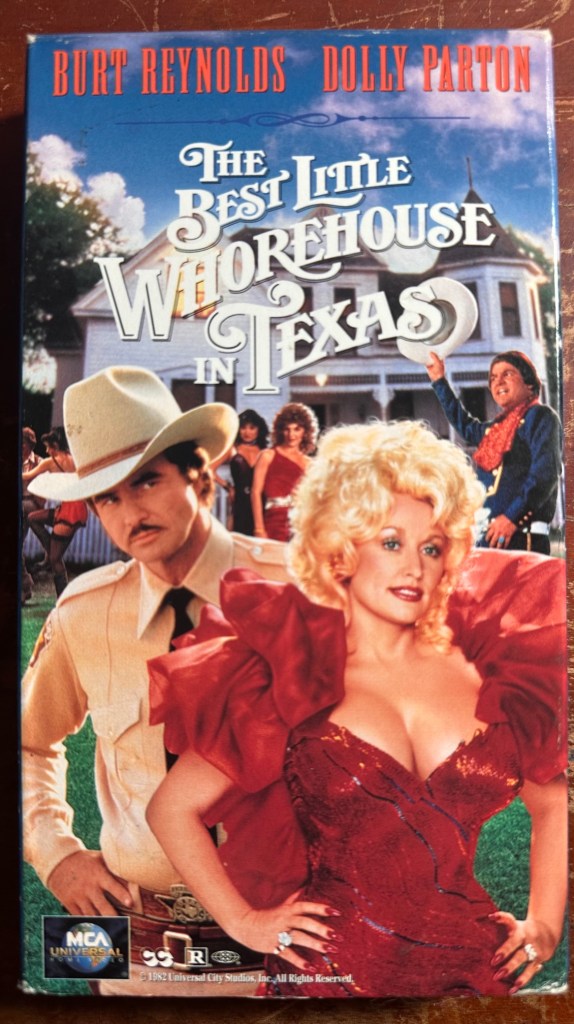
Directed by Colin Higgins
Written by Larry L. King, Peter Masterson and Colin Higgins
1982 | 114 minutes | English
VHS
Dolly Parton, Burt Reynolds, Dom DeLuise, Charles Durning, Jim Nabors, Robert Mandan, Theresa Merritt, Lois Nettleton, Noah Beery Jr., Barry Corbin, Raleigh Bond
What it’s about: The town of Gilbert, TX exists in harmony with the Chicken Ranch, a old-west brothel on the edge of town that has become a local institution, currently being run by Miss Mona Stangely (Parton), who enjoys an ongoing tryst with the town sheriff, Ed Earl Dodd (Reynolds). But this harmony is disrupted by Melvin P. Thorpe (DeLuise), a shit-stirring, fame-seeking investigative journalist from New Jersey by way of Houston. Thorpe’s manufactured outrage reaches a fever pitch after a party at the Chicken Ranch with the Aggie football team, drawing attention from the Governor (Durning) and presenting an existential threat to the future of the Chicken Ranch and perhaps Mona and Ed Earl’s relationship as well.
Reflections: RIP Dolly–pouring it out for a real one. I have a sentimental attachment to this film; it’s weird, a little leaden in places, and was apparently miserable to make, but it’s also some genuine country fun. The songs are great, Burt Reynolds has a little bit of an edge to his grumpy comedy, and Dolly has enough charisma to carry the whole thing, even if it doesn’t fully let her let loose. Dom DeLuise does an awkward boot-scoot in a weird little cowboy outfit and a pageboy haircut. That’s… certainly something to see. Charles Durning got an Oscar nomination for this. It’s very sex-positive and not weird about it. There’s a lot to enjoy.
And while it is absolutely meant to be broad entertainment, there is a certain resonance in it. Underneath the musical coating, you have the archetypal western story: modernity upsetting an older way of life that there’s no going back to. And that modernity reflects ultimately the same late ’70s/early ’80s anxiety in something like Network–Thorpe even tells Ed Earl he and his television show represent the new kind of justice. For all the chuckles and cheery attitude, there is a melancholy to it, and one of Dolly’s best songs gets the heart of that moment (“I Will Always Love You,” written well before the film but repopularized by it).
But more than that, there is an earnestness to the silliness, a kind of old-fashioned, cheesy quality that modern comedy is too self-aware to really replicate, but which still holds up. It’s the kind of movie one wants to watch on a cozy afternoon–light and cheerful, spilling over with star-power, some pathos, but it all turns out all right. Even one of the authors of the original play admitted the work wasn’t exactly Shakespeare, but it’s got heart and charm and is worth watching if you haven’t seen it or revisiting if you have.
 Yeah Dude, Okay