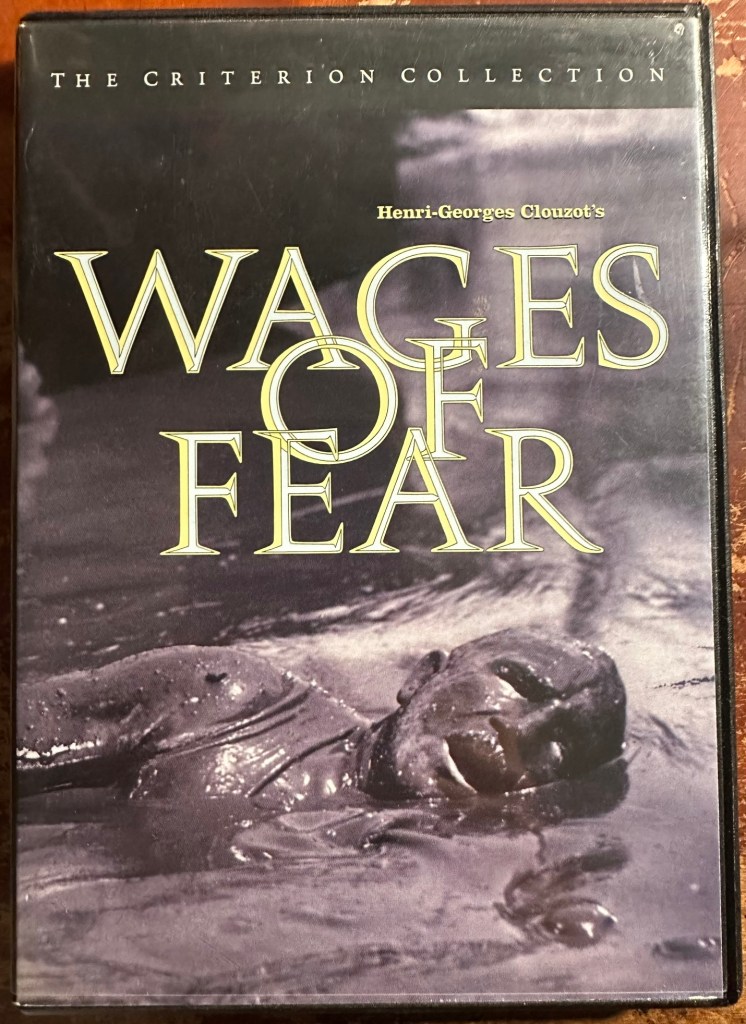
Directed by Henri-Georges Clouzot
Written by Henri-Georges Clouzot & Jérome Geronimi
1953 | 148 minutes | French, Spanish, English, Italian & German
Criterion DVD
Yves Montand, Charles Vanel, Folco Lulli, Peter van Eyck, Véra Clouzot, William Tubbs, Dario Moreno
What it’s about: An isolated South American oil town, only accessible by plane, has collected a disgruntled cadre of drifting foreign laborers–unable to find work or afford the airfare out. Among this wayward group are Mario (Montand), affable but disaffected, especially to the affections of the local cantina girl, Linda (Clouzot); Jo (Vanel), a blustering and conniving fellow Frenchman and one-time gangster; Luigi (Lulli), a hot-headed and big-hearted Italian; and Bimba (van Eyck), a closed-off German survivor of Nazi atrocities. When a remote derrick blows and the only way to put it out is with nitroglycerin charges, these four desperate men are hired for the high-paying but incredibly dangerous job of transporting a large amount of the highly unstable substance in two trucks across hundreds of miles of mountainous desert, decaying roadways, and their own inner terrors.
Reflections: Based on the 1950 novel by Georges Arnaud, this is a classic thriller and remains, even seventy-odd years later, one of the tensest, most uncomfortable experiences in cinema this side of a Safdie film. Clouzout draws out the tension–the movie is long and slow, spending nearly its first half building the atmosphere in the town before the proper adventure kicks off. At first, we see these different men process and react to the purposeless dead-end in which they find themselves. Personalities and prejudices grind against one another as all the different exploitation simmers around. Once the trucks get rolling, though, the stakes become immediately more existential, and the pretensions and ambitions that were built up in the first half are rapidly stripped away.
The sense of doom and mortality in this second half is constant and escalating. The story lingers for achingly long stretches in moments of potential disaster and, even when they are narrowly averted, something unexpected will go wrong instead. The audience is rarely given a chance to breathe, and when they are, the space is filled with the character’s–especially the melodramatic Jo’s–own reactions. As Jo, Vanel convincingly embodies the way his confidence and power is stripped away as a sham, and Montand is sad-eyed and aloof, becoming visibly harder and rawer the deeper into hell he goes.
The film is dark and dour, full of muck and grime both visually and spiritually. It’s also undeniably exciting and shows a mastery of form that put “the French Hitchcock” on the international map, won a bunch of festival prizes, and has been cited as one of the best European films of all time. And watching it now, I’m struck by the salience of its questions about economic survival in desperate circumstances, oil as a corrupting force, and commitment to the dream of a better life, even in the face of deadly insanity.
 Yeah Dude, Okay