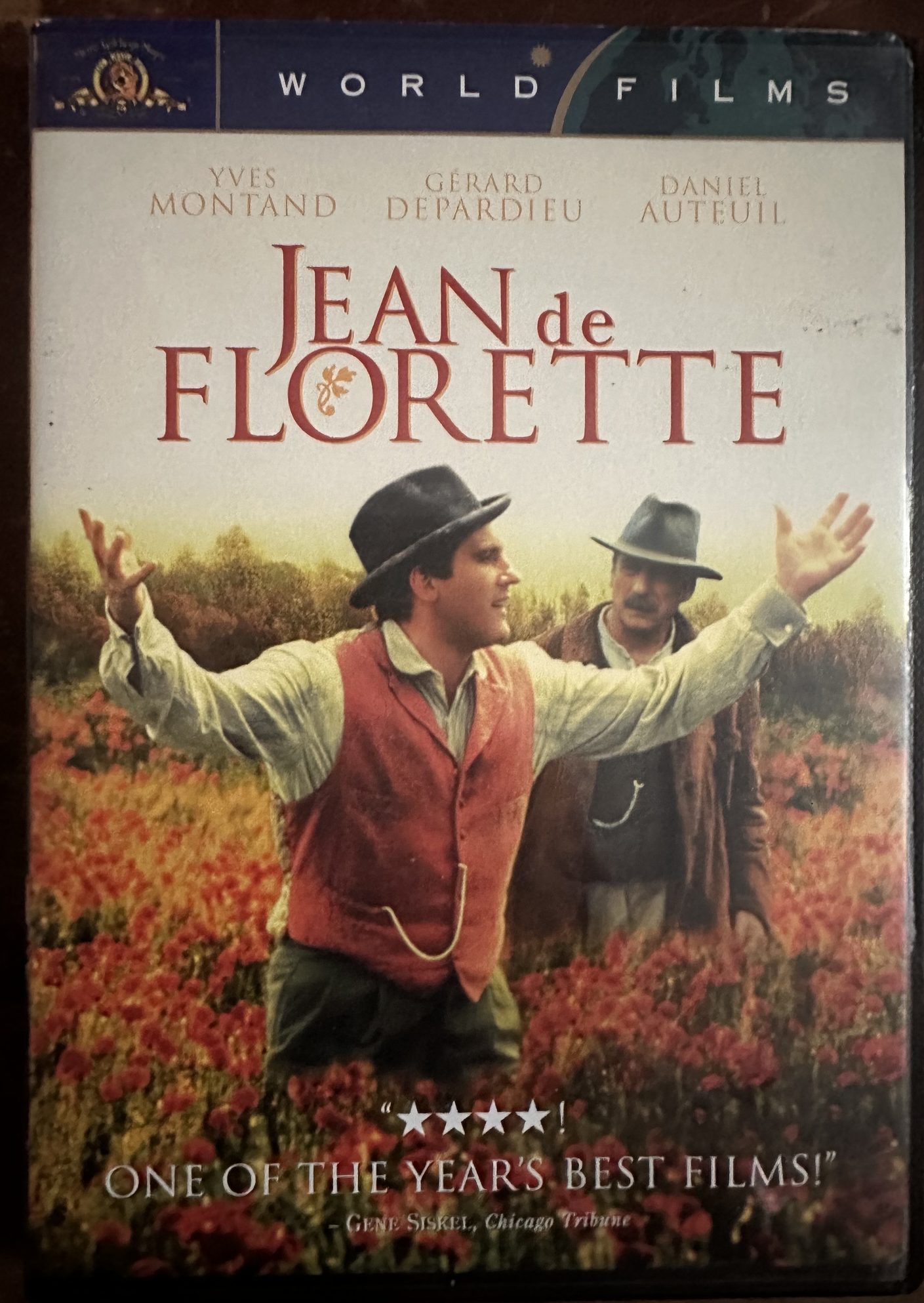
Directed by Claude Berri
Written by Claude Berri and Gérard Brach
1986 | 121 minutes | French
DVD
Yves Montand, Gérard Depardieu, Daniel Auteuil, Élisabeth Depardieu, Margarita Lozano, Ernestine Mazurowna
What it’s about: The first film in a two-part adaptation of Marcel Pagnol’s similarly-bifurcated 1962 novel The Water of the Hills follows the scheming, cynical Césare (Montand) and his softer-hearted but dim nephew Ugolin (Auteuil), who hatch a scheme to start a carnation farm on their neighbor’s land watered by a natural spring. When that neighbor dies, they block the hidden spring to devalue the property, but its inheritance passes to Jean (Depardieu), who arrives with his wife (the other Depardieu) and daughter (Mazurowna), determined not to sell but to start a new life in the country. Under Cesare’s direction, Ugolin forms a confused friendship with the hunchbacked former tax collector, a man who stands out like a sore thumb in the rural community. And as his neighbors wait eagerly for him to fail, the stubbornly-optimistic Jean is pushed to a mental and physical breaking point by the dry, brutal summers, never knowing the answer to his prayers lies waiting right under his nose.
Reflections: This was a first-time watch for me and I came away from it thinking mostly about the tension in it. On the one hand, it’s a warm, gentle film. The sun-dappled Provence landscape with its vivid sunsets and period (early 1900s) gas lamps give it a rich, soft texture, full of earthy mis-en-scene. The characters speak in–what comes across in translation, at least, as–a kind of poetic, stately, theatrical way. Berri, as a director, is patient and restrained, letting the story unfold slowly and naturally, only rarely building up to any big crescendo. There is a classical kind of comfort to the whole vibe of the work. But on the other hand, this gently unfolding story is very much about the rotten center of the human soul–betrayal, greed, cruelty, indifference. These two bitter, self-interested men intentionally break not only a human spirit, but a whole family, for a half-baked idea they barely believe in. And it plays out like a Greek tragedy, pitched as a cozy rural period piece.
Where Montand’s Cesare is all ego and judgement with a friendly tone and Depardieu’s Jean “has GOOD MAN written across his forehead,” as Pauline Kael put it, Ugolin is the heart of the movie, and not for nothing did Auteuil pick up a Cesar award for this. The more he gets to know Jean and his family, the more aware he is that what he’s doing is fundamentally wrong, but while he’s sensitive enough to be aware of that conflict, he’s not smart enough to figure out what to do about it. And the vague, existential pain of that is all over Auteuil’s face in every moment. Also of interest is Jean’s daughter Manon, who ultimately sees through her neightbors’ scheme, and whom Mazurowna gives an unusually steely stare for a child that will set up the sequel (Manon of the Spring, also 1986).
I will admit, when this came up on the randomizer, I felt a little resistance to the idea of a slow, moody French period piece. And it is that–it’s not a movie in a hurry to grab your attention. But, like good French cooking, it’s also this rich, succulent experience–I found myself casually drawn into it until I was enveloped. There is art that is powerful because it pushes new ideas, and there is art that is powerful because it deftly captures what’s still interesting about older ones, and this is an excellent example of the latter. I look forward to the conclusion when it comes up on rotation.
 Yeah Dude, Okay