Directed by Fenton Bailey & Randy Barbato
Written by Fenton Bailey & Randy Barbato
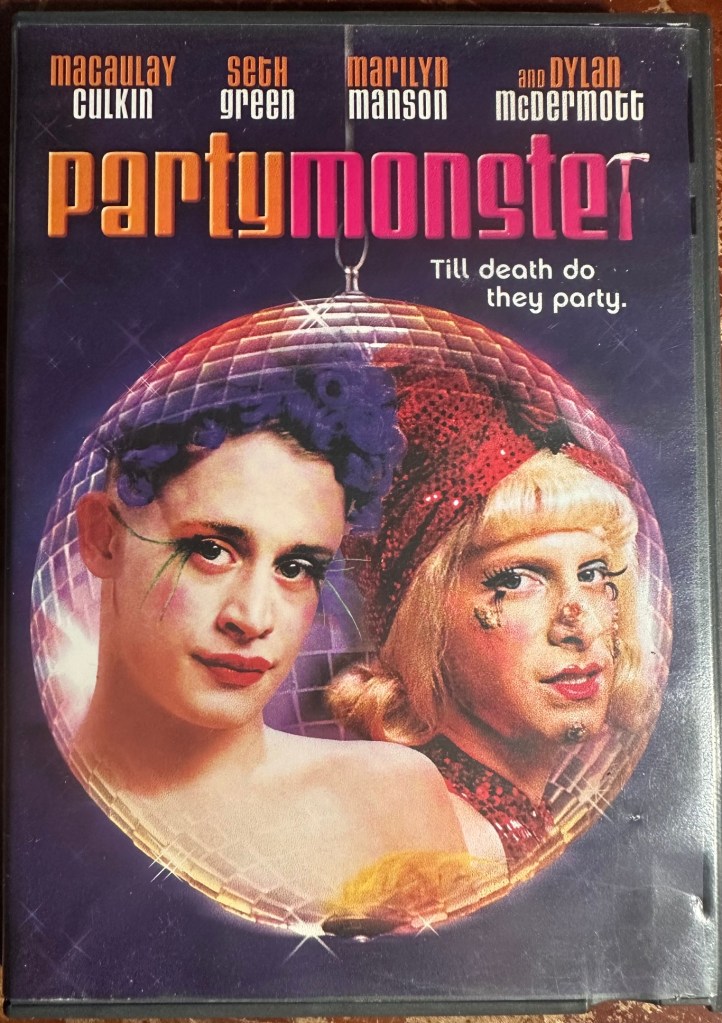
2003 | 99 minutes | English
DVD
Macaulay Culkin, Seth Green, Chloë Sevigny, Diana Scarwid, Wilmer Valderrama, Natasha Lyonne, Wilson Cruz, Dylan McDermott, Marilyn Manson, Mia Kirshner, John Stamos
What it’s about: Based on the 1999 memoir Disco Bloodbath by James St. James (Green), who narrates the rise and fall of Michael Alig (Culkin). Michael moves to New York City in the early 1980s and is taken under St. James’ wing, becoming enamored of the city’s glamorous nightlife. Landing a job at the Limelight club, run by Peter Gatien (McDermott), Alig’s natural charisma and edgy personality quickly make him a rising star in the club scene, the host of increasingly hedonistic parties. But as Michael and the other Club Kids’ profile rises, he also descends further into madness and drug addiction, culminating in the murder of Michael’s friend and dealer, Angel (Cruz).
Reflections: My impression of this movie, seeing it for the first time in nearly 20 years, is very similar to what I felt when I first watched it. It should work, all the elements are there. Culkin gives a surprisingly fearless performance as Alig, leaning into both the outsized, infectious drama and depraved vacuity–he’s both charming and unpleasant, magnetic and pathetic, and one never feels as though the actor his holding back from the character. The supporting cast is full of hip names in small roles who are all fun to watch (and also Marilyn Manson, less acting than cackling and vamping through a bit part until he dies offscreen). The soundtrack is full of canny choices. The look of the film is colorful and vibrant. And the somewhat insufferable fabulousness is on point.
But there is a kind of emptiness to the whole exercise I wrestle with. Because on the one hand, that’s kind of part of it–Michael and James pride themselves on their irony-soaked superficiality, unwilling and unequipped to deal with the serious, “after school special” aspects of their lives or consequences of their choices. For a film about them to be a trenchant drama would, in some ways, be a betrayal of its subjects. But that also creates a distance from the audience–it’s difficult to walk away from this feeling like one has a real sense of Alig as a character or insight into the true story that inspired it. There is something to be pulled out of it, but it takes a little more openness and work as a viewer than, I think, many people might be willing to give it, and if one isn’t, it could easily come off as flat, obnoxious or tedious, despite the individual elements all firing.
But it is fascinating as a kind of doubled document of culture in a time and place–on the one hand, the strangely hedonistic, plastic-art fueled New York scene of the ’80s and early ’90s that it documents, and on the other, the early ’00s hipster film culture of the document itself. And to the right sensibility, there is a certain “dream the impossible dream” tragedy to the tale and a cachet to the eccentric way in which it’s told. Whether the film is successful is a matter of temperament, but if it’s a failure, it’s at least an interesting one and worth watching for that, even if anything deeper going on within it is held at arm’s length.
 Yeah Dude, Okay